UHR Payslip Salary Deductions: PAYE, SHIF, NSSF & More
Getting your salary is one thing; understanding the amount shown on your UHR payslip is another. Your gross salary may be higher than the amount you actually receive because applicable taxes, statutory contributions, loan repayments, and other authorised deductions can reduce your final pay.
If the figures on your payslip do not seem to add up, a closer look at the deductions can help you find where the difference comes from. It also lets you check your take-home pay and compare it with previous months for clarity.
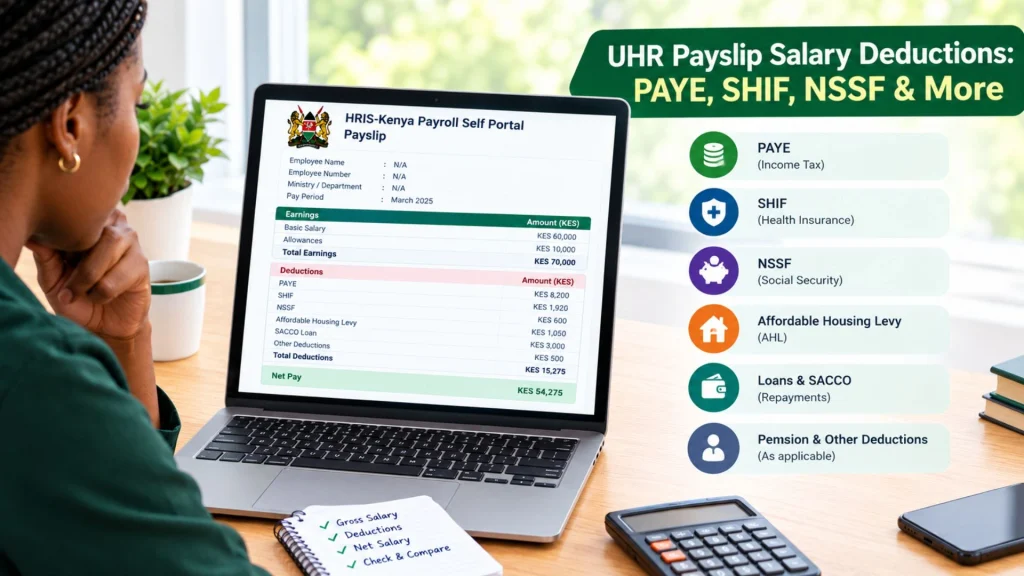
In the guide below, we’ll break down UHR payslip salary deductions, show how they affect your final pay, and explain what to check when the amount on your payslip is different from what you expected.
What Do Salary Deductions Mean on a UHR Payslip?
Salary deductions are amounts taken from your earnings before your net salary is paid to you. Some deductions are required by law, while others come from your own financial or employment arrangements.
For example, PAYE, SHIF and NSSF are different from deductions for a SACCO loan or other personal commitments. Your payslip can show the deductions applied to your salary and help you understand how they affect your final pay.
Common UHR Payslip Salary Deductions
The deductions shown on a UHR payslip can vary from one employee to another. However, several common deductions can appear.
PAYE
PAYE stands for Pay As You Earn. It is income tax deducted from employment income by the employer and remitted to the Kenya Revenue Authority (KRA). Kenya’s current individual income tax bands range from 10% to 35%, depending on taxable income.
The current personal relief for eligible resident individuals is KSh 2,400 per month. The PAYE amount on your payslip is therefore not simply a fixed percentage of your entire salary.
SHIF Contribution
A UHR payslip may also show a deduction for the Social Health Insurance Fund (SHIF), which replaced the previous NHIF contribution system. Under the Social Health Insurance regulations, salaried households contribute 2.75% of gross salary or wages, with a minimum monthly contribution of KSh 300.
NSSF
NSSF stands for the National Social Security Fund. It provides social security savings for employees. NSSF contribution rates have been adjusted over time, so don’t rely on an old payslip example when calculating current deductions.
For 2026, NSSF published its Year 4 contribution rates, so the amount deducted may differ from older payslip examples. The actual amount depends on the applicable pensionable earnings and contribution limits. The actual amount appearing on your payslip depends on the applicable pensionable earnings and the current contribution limits.
Affordable Housing Levy
The Affordable Housing Levy (AHL) is another deduction that can appear on your payslip.
The employee contribution is 1.5% of gross monthly salary, while the employer contributes an additional 1.5%. KRA also confirms that the employee’s Affordable Housing Levy is taken into account when determining taxable employment income.
Because the employee contribution is based on gross monthly salary, a change in gross pay can affect the amount deducted.
Pension or Retirement Contributions
Depending on your employment arrangement, your payslip may show pension or provident fund contributions.
These deductions are intended to build retirement savings. The amount can depend on the applicable pension scheme and the rules governing your employment.
Pension deductions may differ depending on the employee, so always refer to your payslip for the specific deduction amount and details.
Loans and Salary Advances
If you have an outstanding government, bank, SACCO, or other authorized loan, its repayment appears as a salary deduction.
The same applies to an approved salary advance. Unlike statutory deductions, these amounts are generally connected to a particular financial commitment. If your loan repayment period ends, the deduction should normally stop according to the relevant repayment arrangement.
SACCO and Other Deductions
SACCO contributions, welfare contributions, union deductions and other authorised payments also appear on a UHR payslip.
Deductions can be different from one employee to another, so don’t assume that a deduction on someone else’s payslip should also appear on yours.
Gross Salary vs Net Salary
One of the easiest ways to understand your payslip is to separate gross salary from net salary.
Gross salary is the total salary before applicable deductions. Net salary is the amount remaining after the relevant deductions have been taken out. This is generally the amount paid to you after applicable deductions.
For example, suppose an employee has a gross monthly salary of KSh 80,000. The final take-home pay will not necessarily be KSh 80,000 because applicable taxes, statutory contributions, pension payments, and other authorised deductions can reduce it.
The exact net salary cannot be determined by simply applying one standard percentage, as employees may have different taxable benefits, reliefs, and personal deductions.
How Do UHR Payslip Deductions Affect Net Salary?
UHR payslip deductions reduce the amount of salary you receive after gross earnings are calculated. The final net salary depends on the deductions that apply to your individual employment, statutory contributions, pension arrangements, loans, and other authorised payments.
Because deductions can differ between employees, two employees with the same gross salary may not necessarily receive the same net salary.
How to Check Your UHR Payslip Deductions
When reviewing your payslip, do not look only at the final amount. Instead, check each section properly:
If one deduction has increased, try to identify whether your salary, contribution rate, loan repayment, or another payroll factor has changed.
Conclusion
Understanding UHR payslip salary deductions does not have to be complicated. The key is to look beyond your final net salary and understand what each deduction represents. PAYE relates to income tax, NSSF relates to social security contributions, and the Affordable Housing Levy is another statutory payroll deduction.
Other amounts, such as loans, pensions and SACCO contributions, depend on your individual circumstances. Because Kenyan payroll rules and contribution rates can change, it is also important to use current information when checking your payslip rather than relying on an old salary example.